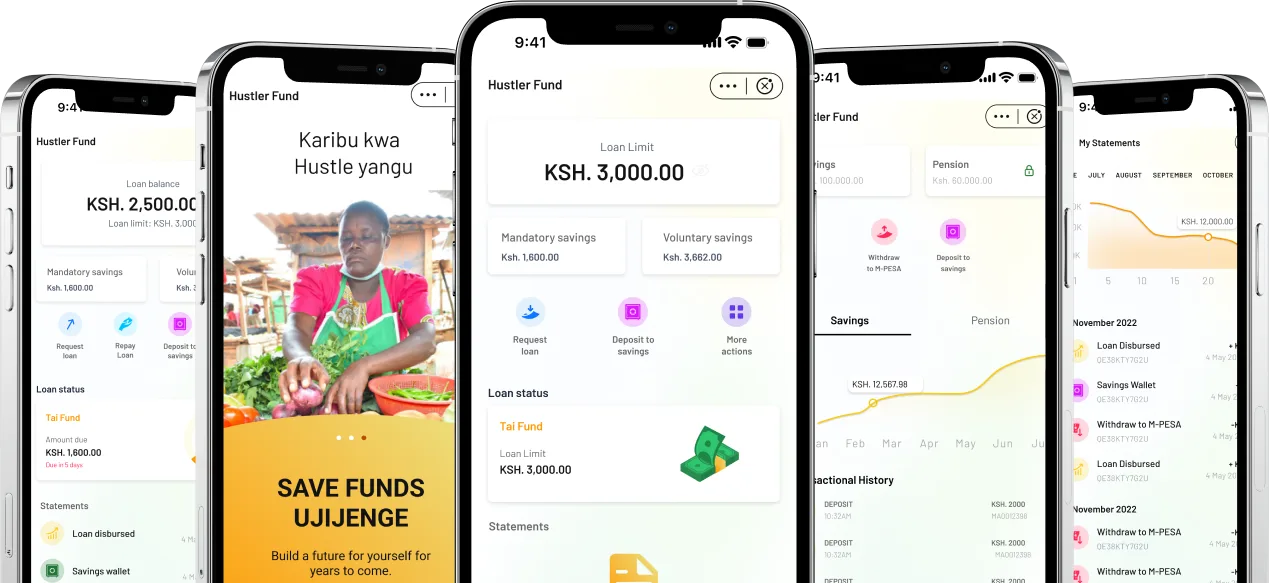
A national initiative for financial inclusion
Hustler Fund is a Government of Kenya initiative designed to improve financial inclusion by providing affordable credit and micro-pension products to underserved citizens and MSMEs.
The initiative targets Kenyans at the bottom of the economic pyramid, representing:
- 80%+ of the workforce
- 33% of Kenya's GDP
The objective was to:
- Promote a culture of saving
- Improve access to affordable credit
- Reduce dependence on predatory lenders
- Cushion citizens against economic shocks
- Support business growth
The product launched with:
- Personal Loan Product (PLP) — Launched on 30 November 2022
- Micro Enterprise Loan (Biashara Loan) — Launched on 2 February 2023
More than a loan product
This wasn't simply a loan product. It was a national-scale initiative designed to expand financial access to millions of Kenyans who have historically been underserved by traditional financial institutions.
Designing for this audience required balancing:
- Simplicity
- Trust
- Accessibility
- Financial literacy
- Speed to market
Designing at speed under constant change
The project had aggressive delivery timelines. Requirements evolved rapidly as stakeholders refined the product vision and policy requirements.
We needed to:
- Design at speed
- Align multiple stakeholders
- Iterate continuously
- Maintain simplicity despite increasing complexity
How might we deliver an intuitive financial experience while adapting to constant change?
The Team
- Kelvin Mutiso — Design Lead
- Mumbe Mutuku — Research Lead
- Mary Mbaire — UI/UX Designer
- Clement Ngatia — UI/UX Designer
- Brandon Kahuho — Customer Journey Expert
- Stella Kambua — Customer Journey Expert
- Violet Akinyi — Business Analyst
- Gilbert Kiprop — Developer
UI/UX Designer
I was responsible for translating user needs, business requirements, and market insights into intuitive customer journeys.
- Stakeholder collaboration
- User flow design
- Wireframing
- Prototyping
- Interaction design
- Design reviews
- Iterative refinement
A sprint-based approach to meet delivery timelines
Aligned on product vision, objectives, business goals, user needs and success metrics — critical as requirements evolved.
Translated requirements into user stories covering opt-in, loan limits, requests, repayments, balances, savings and beneficiaries.
Explored multiple concepts through design workshops, sketching sessions and collaborative reviews before converging.
Transformed concepts into low-fidelity and high-fidelity prototypes, with each review cycle informing the next iteration.
Designing for individuals and small business owners
The target audience included individuals and small business owners with limited access to affordable financial products.
Runs a grocery business and needs capital to expand.
- Access affordable credit
- Grow her business
- Avoid predatory lenders
- High borrowing costs
- Collateral requirements
- Poor lending experiences
Looking to start a small side business.
- Access low-interest financing
- Flexible repayment options
- Financial independence
- Limited financing options
- High borrowing barriers
Translating needs into the experience
- As a user, I want to opt into and access the services intuitively.
- As a user, I want to check my loan limit so I know how much I am eligible for.
- As a user, I want to request a loan by providing the amount so it can be approved.
- As a user, I want to check my loan balance so I can keep track of what I owe.
- As a user, I want to repay my loan so I can clear my debt and maintain a good credit score.
- As a user, I want to view my loan transaction history so I can see my repayment progress.
- As a user, I want 5% of my loan transferred to savings — 3% to pension and 2% to a savings account — so I can build a culture of saving.
- As a user, I want to add emergency contacts and beneficiaries of my assets.
Three principles guided every decision
Financial services should be easy to understand regardless of financial literacy.
Reduce complexity and guide users confidently through every step.
Encourage healthier financial habits that go beyond borrowing.
An experience that goes beyond lending
Simple onboarding into the Hustler Fund ecosystem.
Quick access to personal and business credit.
Automatically allocate a percentage of every loan toward savings and pension.
Monitor balances, repayments and transaction history.
Add emergency contacts and beneficiaries of assets.
Meaningful outcomes at national scale
The project demonstrated how rapid collaboration and continuous iteration can deliver meaningful outcomes at scale.
What this project taught me
- Alignment accelerates delivery — moving fast requires clarity and shared understanding across teams.
- Design is a continuous conversation — the strongest solutions emerged through constant feedback and iteration.
- Simplicity creates inclusion — financial products only create impact when they're accessible to the people who need them most.
Designing at speed is about making the right decisions quickly
This project reinforced that designing at speed isn't about skipping process. It's about making the right decisions quickly, collaborating effectively, and continuously adapting as new information emerges.
In fast-moving environments, alignment becomes just as important as design craft.
Curious about the research or the design decisions behind this work?
Get in touch